

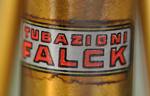
In my entry about Falck steel tubing for bicycles it appears my reference was incorrect about "Libellula" (dragonfly) type tubing as coming from Falck.
The correct manufacturer was Castello Mario & Figlio of Torino.
Martin Appel provided a German catalog from 1951 showing the specifications for Libellua, and photos of his own Rabeneick bike from 1961 which is built from Libellula and which has the dragonfly logo clearly stamped on the fork (the top tube was stamped as well but was less clear in the photo).
This photo is of another Rabeneick bike with the dragonfly stamping:

Another dragonfly stamping:

More information about Castello Mario & Figlio is desired.
By the way, there is an extensive story here about Columbus tubing.
Photos: click to enlarge
Stories for the Italian Cycling Journal welcome; contact me at veronaman@gmail.com. There are more than 1,100 stories in this blog; the search feature to the right works best for finding subjects in the blog.
The correct manufacturer was Castello Mario & Figlio of Torino.
Martin Appel provided a German catalog from 1951 showing the specifications for Libellua, and photos of his own Rabeneick bike from 1961 which is built from Libellula and which has the dragonfly logo clearly stamped on the fork (the top tube was stamped as well but was less clear in the photo).
This photo is of another Rabeneick bike with the dragonfly stamping:

Another dragonfly stamping:

More information about Castello Mario & Figlio is desired.
By the way, there is an extensive story here about Columbus tubing.
Photos: click to enlarge
Stories for the Italian Cycling Journal welcome; contact me at veronaman@gmail.com. There are more than 1,100 stories in this blog; the search feature to the right works best for finding subjects in the blog.




 Posts
Posts


