Wednesday, February 23, 2011

The Journey to Copenhagen World Championships Begins


The journey to the Copenhagen World Championships (September 19 to 25) begins next week for the Italian national team. Members of the squad will be in Livorno from February 28 to March 3rd to focus on the discipline of time trialing.

It's the first stage of a three stage process aimed particularly at young riders. Participating under under C.T. Paolo Bettini, the U23 C.T. Marino Amadori, and Scuola dello Sport del Coni people, are riders:

National Professionals:
Alfredo Ballon - Lampre-Isd
Dario Cataldo - Quickstep
Adriano Malori - Lampre-Isd
Alan Marangoni - Liquigas-Cannondale
Marco Pinotti - Htc-Highroad
Manuel Quinziato - BMC Racing Team

National Under 23:
Diego Florio - G.S. Zalf Desiree Fior
Gianluca Leonardi - Site Marchiol Tassullo
Matthew Mammini - Mastromarco Chianti Sensi Benedetti
Alessandro Stocco - U.C. Treviso Bottoli Dynamon

Also, during the "Progetto Azzurro" there will be courses such as "The sense of belonging in modern cycling team", "The time trial: The performance model and its preparation", and the first lesson of "English for London 2012".

Photo: Marco Pinotti, five-time Italian Time Trial Champion (2005, 2007, 2008, 2009, and 2010).

Follow on Twitter: ITALIANCYCJOURN

Stories for the Italian Cycling Journal about rides, granfondos, having a good time cycling in Italy, Italian cycling history, etc. are always welcome. Contact me at veronaman@gmail.com. There are more than 1,700 stories in this blog. The search feature to the right works best for finding subjects in the blog. There is also an Italian weather widget along the right side and a translate button at the bottom so you can translate each page. What I'm riding.

Tuesday, February 22, 2011

Multi-Stage Gran Fondo: LA HAUTE ROUTE


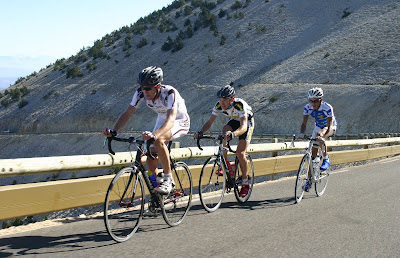
A new event on the gran fondo calendar is the multi stage "LA HAUTE ROUTE". Although it doesn't take place in Italy I thought I write about it as it comes very close to Italy on its way from Geneva to Nice, and it sounds like such a great challenge.

The first edition of the HAUTE ROUTE (the ‘high road’) is an exceptional cyclosportive (gran fondo) event involving 7 stages, 14 cols between Geneva and Nice, that will take place over 7 days from 21-27 August, 2011. Riders will be challenged as they climb over 14 legendary Alpine Cols between Geneva and Nice. 700 km, 18,000m of climbing, 7 days of pleasure and pain.

With more than 700 kilometres to cover and around 18,000 meters of altitude to climb and as much to descend, the competitors will have the amazing opportunity to measure themselves against 14 famous cols, including the Madeleine, Galibier, the Izoard and the Cime de la Bonnette on a route that climbs above 2,800 metres. The first edition of La Haute Route will stop in the prestigious ski resorts of Megève, Les Arcs/Bourg-St-Maurice, Serre Chevalier, Pra Loup and Auron.

The organizers are estimating between 500-600 entries for the inaugural event. Registration deadline for the Haute Route is 31 July 2011. Registration is Euro 630, lodging packages are available from the organizer.

Read all details at www.hauteroute.org

Course overview by Claude Droussent, Ex-Chief Editor of the newspaper group L’Equipe:

Saturday 20th August 2011: La Haute Route Village, Geneva
Sunday 21st August 2011 : Geneva – Megève (97 km)
"Beware! Neither the distance (97 km) nor the altitude of the first two cols of the Haute Route, the Colombière and the Aravis, should scare you. However the ascent of the Colombière by its north side is a “two-faced” friend. The first ten kilometres, up to the Reposoir, are “soft”; the last six surrounded by a rocky landscape have a gradient between 8.5 and 10%.

Once you have freed yourself from this first col of the week (1616 meters), the descent of the south side is not too punishing until Saint-Jean-de-Sixt. From there, you’ll head towards La Clusaz and then turn right for the last eight kilometres of the Aravis. It is a cool route with an average 5% gradient, green scenery, the mont Blanc on your left at the summit and with a bit of luck, marmots! Save yourself some strength for the light final ascent to Megève. And then relax; it is only the first day after all…"

Monday 22nd August 2011 : Megève – Les Arcs (103 km)
"It starts with the col des Saisies which should be okay. After the funny hairpin bends overlooking Flumet, there will be 15 kilometres of irregular but not too nasty slopes offering even a section to recuperate at mid-col near Arcanière. And above, weather permitting, the enchanting mont Blanc!

Keep some strength for the Cormet de Roselend that is split in two parts when you tackle it by Beaufort. The first ten kilometres go up on a 6 to 8% gradient to the levee and balcony of the Col du Méraillet where you will need to recuperate; and then another 6 to 8% gradient on the last five kilometres up to 1967 meters in altitude. It is high but not so difficult. Be careful at mid-descent, after the Saint-Antoine bridge, the going is very fast on a very narrow road, even some professionals have fallen off into the ravine!

Past Bourg-Saint-Maurice, 15 kilometres of ascent on a beautiful road up to the Arcs 1800 remain with a regular ascent of 6-7%. A 103 km day that will be a little more demanding than the previous one."

Tuesday 23rd August 2011 : Bourg-St-Maurice – Serre Chevalier (162 km)
"The big day! Because it is the third day and your legs will start to hurt; because there are 162 kilometres on the clock and it will be the longest stage of the week; and, more importantly, because you will have to climb consecutively the Madeleine, the Télégraphe and the Galibier. A big and beautiful mountain leg! Fabulous!

The first part of the Madeleine via Aigueblanche is not very complicated. The last twelve kilometres however will offer no respite with an ascent between 7 and 9% gradient after Celliers, with rocky surroundings up to 1993 meters. Enjoy the descent to recuperate: the Maurienne Valley is never simple to broach, you could have a headwind all the way to the bottom of the Télégraphe!

Then it’s time for the “pièce de résistance”: the Télégraphe with the road bending through the middle of a pine forest. Ten kilometres with a regular ascent at 7%. Here we go! The small descent to Valloire and then the Galibier. The col King of the Alps, the one that inspired the famous drawings of « L’Homme au marteau » from Pellos awaits you, with its irregular percentage which is harsh for morale because it is almost a straight line all the way to Plan Lachat.

Then, the “real” col starts: 8 kilometres at 9 to 10% all the way up to 2637 meters. The main difficulty of the Galibier, which is really the main challenge of the Haute Route, is here, over the last 8 kilometres across a dreamlike landscape, but with a lack of oxygen above 2000 meters! One must really think concentrate over the Madeleine and the Télégraphe, to manage your energy consumption, otherwise the Galibier could really become a nightmare. At the summit, at kilometre 140, it’s a done deal! However, it goes all the way down to Serre-Chevalier and if you’re not too exhausted, enjoy yourself!"

Wednesday 24th August 2011 : Serre Chevalier – Col du Granon (12 km, time trial)
"Isn’t this a funny idea, a time trial on the Granon roads, an unknown col leading nowhere except 2413 meters high, facing the magnificent barrier of the Ecrins? My advice is warm up whilst going up to the Lautaret! Because the Granon, where the pros once went through (and arrived as it is a dead-end) in 1986 with a LeMond-Zimmermann duel, is a tough one right from the bottom and exit of Saint-Chaffrey. So 12 kilometres only on the menu, but 11 of them with hellish gradients, never below 8% and parts at 11-12%. Respect to those who, on this fourth day and with what’s been served up the day before, will take less than an hour to get to the top."

Thursday 25th August 2011 : Serre Chevalier – Pra Loup (119 km)

"Here again, a monster after Briançon but broached by its “cool” side. However, it is the Izoard by its north side so it won’t be the famous Casse Déserte that you will tackle in the descent. But a long ascent (20 kilometres) surrounded by pine trees, difficult in its second part after Cervières. Along the last nine kilometres up to 2360 meters high, it never goes below 8-9%, especially near the Refuge Napoléon.

Same thing for the col de Vars culminating at 2111 meters. And it is the bottom that is very difficult after Guillestre - 18 kilometres of ascent is long. The 8 kilometres of the final ascent to Pra Loup after Barcelonnette won’t be so simple. Remember Eddy Merckx’s lapse in 1975, and Bernard Thévenet glorious day… After the Galibier’s day, the second hardest day of the week."

Friday 26th August 2011 : Pra Loup – Auron (78 km)
"Enjoy, if you still can! The Cime de la Bonnette is 25 kilometres of ascent from Jauziers at 2802 meters high making it the highest road in Europe and the “roof” of the Haute Route, its all yours! Especially a breathtaking scenery in an incredible silence in the heart of the Parc du Mercantour. The Galibier is stunning, the Bonnette even more so. A world of its own…

But you have to work for it. You’ll often face 8-9% slopes but you will also have to be able to “recuperate” on the long parts at 5%. The Bonnette showcases irregular slopes. You should expect two hours of ascent, a little bit more if you want to enjoy the surroundings. It is even better than making a good performance here. And this way, you can also save some energy because even if there is only 77 kilometres to reach Auron, the final ascent has a 8-9% gradient…"

Saturday 27th August 2011 : Auron – Nice (145 km)
"Today, you are probably shattered, waking up every morning has become harder and harder. But today you will be rewarded by the crossing of the Mercantour, the backcountry and then Nice, the coast, the sea… The col de Saint-Martin with its 1500 meters above the Vésubie is nothing compared to what you have already overcome. Beware of the distance, however, 145 kilometres, it could be long. And at the finish, I dare you, dive into the Mediterranean blue sea, you’ve earned it!"

Follow on Twitter: ITALIANCYCJOURN

Stories for the Italian Cycling Journal about rides, granfondos, having a good time cycling in Italy, Italian cycling history, etc. are always welcome. Contact me at veronaman@gmail.com. There are more than 1,700 stories in this blog. The search feature to the right works best for finding subjects in the blog. There is also an Italian weather widget along the right side and a translate button at the bottom so you can translate each page. What I'm riding.

Monday, February 21, 2011

2011 Giro di Sardegna, 22 to 26 February


The five day Giro di Sardgena (Sardinia) stage race gets under way tomorrow. The five stages are Olbia to Porto Cervo, Porto Rotondo to Nuoro, Orani to Lanusei, Lanusei to Oristano, and Oristano to Gesturi.

The big name Italian riders are Vincenzo Nibali, Daniel Oss, Alessandro Petacchi, Damiano Cunego, Danilo Di Luca (yes, HE'S BACK!), Michele Scarponi, Stefano Garzelli, and Alessandro Ballan.

Teams:
Liquigas - Cannondale
Lampre - ISD
Androni Giocattoli - Bianchi
Pro Team Astana
BMC Racing Team
Katusha Team
Team Radioshack
Acqua & Sapone
Colnago CSF Inox
Miche - Guerciotti
Team Spidertech
Great Britain National Team

The RAI2 TV schedule:
Martedì 22 febbraio: ore 19,00. Replica ore 22,30
Mercoledì 23 febbraio: ore 20,00. Replica ore 22,30
Giovedì 24 febbraio: ore 19,00. Replica ore 22,30
Venerdì 25 febbraio: ore 19,00. Replica ore 22,30
Sabato 26 febbraio: ore 22,30

Follow on Twitter: ITALIANCYCJOURN

Stories for the Italian Cycling Journal about rides, granfondos, having a good time cycling in Italy, Italian cycling history, etc. are always welcome. Contact me at veronaman@gmail.com. There are more than 1,700 stories in this blog. The search feature to the right works best for finding subjects in the blog. There is also an Italian weather widget along the right side and a translate button at the bottom so you can translate each page. What I'm riding.

The Return of Rossin, Part II


Part I

Nick from Grupetto Italia, of England, provides a new new update on the Rossin portfolio of products. Nick from Grupetto Italia, writes, "Rossin will be a familiar name to anyone who has followed bike racing in Europe over the past 4 decades having supplied its Italian made bikes to some of the most successful teams in professional racing during this period. It is now ready to make a welcome return in the UK exclusively through purveyors of all things good in Italian bikes, Grupetto Italia...

The Rossin name will be remembered by many with ‘Day Glo’ tinted specs as the ultimate late eighties racing machine (with the loudest paint jobs on the road). Rossins were ridden by some of the best riders of the time including Roger De Vlaeminck and his Daf trucks team and the Dutchman Hennie Kuiper who won both Milan San Remo and Paris Roubaix on Rossin bikes. Kuiper leading in 1985 Milan-San Remo:

Established in 1974, Mario Rossin who had worked for Ernesto Colnago for years was respected as one of the best frame builders in the business with a reputation as a wizard for measuring and custom building for the top Italian riders, so when Rossin started doing his own thing it was no surprise that racing success soon followed.

Italian riders like Gibi Baronchelli who had ridden his bikes as an amateur soon helped Rossin move into the Professional ranks and in early 1976 the GBC Itlia squad were the first of many teams to lineup on Rossin bikes at the Laigueglia Trophy, the traditional early season opener and the rest as they say is history.

It was a Golden era for the Italian cycle industry and Rossin developed many of the advances in technology that other builders later adopted, including the first sloping top tubes and ‘horned’ handlebar TT and track bikes used by both the Russian and US team at the LA Olympics; remember Eric Heiden, he rode Rossin and later by Viatchelav Ekimov when he claimed the Indoor hour record on a Rossin by riding 49.672km.

In 1983 Rossin developed the very first Disc wheels on their ‘FuturaCX’ bikes and they are also credited with equipping one of their bikes with the first onboard computer. In 1980 a little known rider called Alesandro Pagenessi was used as a guinea pig during the Settimana Lombarda mountain time trial, coming second only to the great polish rider Cezlaw Lang – apparently the computer was the size of a brick lashed to his bars but look what a revolution he started. Moreno Argentin later wore pink at the Giro on a Rossin and the company continues to this day to push the established ways of building racing bicycles aimed at the very best riders at the highest levels of competition.

This constant striving for advancement in making bikes both faster and better performing is still evident today in the new range of Rossin Bikes. The range is led by the fantastic looking Ghibli made from 1K high module carbon, the chunky yet aerodynamic head tube looks glorious up front with the monostay and integrated seat post (ISP system) at the back making this pure Rossin magic – although you’ll be glad to know the paint finish, (whilst lustrous) is much subtler than in previous times.


Next in line is the Kubang which whilst being incredibly light and responsive still has superb absorbing qualities for a comfortable ride over long distances. Next in line is the Kubang which whilst being incredibly light and responsive still has superb absorbing qualities for a comfortable ride over long distances. It's ideal for racing or sportives and the monocoque 3K Kubang has the same ISP system as the Ghibili giving it the credible good looks of a true racing machine. Further down the range but still aimed at the Sportive / club racer is the Zenith with its 12K Toray monocoque frame offering outstanding ride quality, strength and lightness."

More information can be found on the Grupetto Italia website.

Photo (top): Always at the front of innovations, Rossin have been instrumental in some of the most radical thinking, working alongside the best riders they have always prided themselves on researching and developing the best new ideas

Follow on Twitter: ITALIANCYCJOURN

Stories for the Italian Cycling Journal about rides, granfondos, having a good time cycling in Italy, Italian cycling history, etc. are always welcome. Contact me at veronaman@gmail.com. There are more than 1,700 stories in this blog. The search feature to the right works best for finding subjects in the blog. There is also an Italian weather widget along the right side and a translate button at the bottom so you can translate each page. What I'm riding.

Sunday, February 20, 2011

Alitalia & Gran Fondo Colnago Partnership


Gran Fondo USA, organizer of the Gran Fondo Colnago series in the United States, has announced a partnership with Alitalia Airlines as the "Official Airlines sponsor". As its official airlines, Alitalia will help make the Gran Fondo Colnago events more accessible to Italian cycling enthusiasts. In addition, for each of the events organized by Gran Fondo USA, Alitalia will offer two free trips to Italy to two lucky participants in the events. What a great idea!

These trips will be organized in conjunction with other partnerships with Gran Fondo USA: Italy Bike Hotels (www.italybikehotels.it), which will offer lodging in hotels that are cycling friendly and Marca Treviso (www.marcatreviso.com), which will host the lucky winners of the contest at its facilities in Treviso at the Prosecco Cycling Classic on October 2, 2011. Video from a La Prosecco:

PCC 2009 from iamin on Vimeo.


Check www.granfondousa.com for updates on the event series how you can win a week-long trip to cycle the historic roads of and passes of Italy, thanks to Alitalia. Events are currently scheduled for:
San Diego, April 10
Los Angeles June 26
Philadelphia, August 14
Miami, November 20

Follow on Twitter: ITALIANCYCJOURN

Stories for the Italian Cycling Journal about rides, granfondos, having a good time cycling in Italy, Italian cycling history, etc. are always welcome. Contact me at veronaman@gmail.com. There are more than 1,700 stories in this blog. The search feature to the right works best for finding subjects in the blog. There is also an Italian weather widget along the right side and a translate button at the bottom so you can translate each page. What I'm riding.

Saturday, February 19, 2011

Economics of the Giro D'Italia


The 2011 Giro d'Italia, "La Corsa Rosa", is one of the three events selected to offically celebrate the 150th anniversary of the unification of Italy (150° Anniversario dell’Unità d’Italia); the other two events are the Coppa Italia and the Festival di Sanremo.

The start of the Giro will take place in Torino, the first capital of unified Italy, on May 7, 2011.

The Director of the Giro, Angelo Zomegnan, said in San Remo on Thursday, "The Giro d'Italia by definition unites the country and this year will try to do so even more than before. Although we are obligated to remain within a distance of 3500 km we have managed to touch 17 of the 20 regions, more than 60 of the 110 provinces and over 550 municipalities. I think the pink thread that joins these cities, provinces and regions will be the ideal moment to emphasize even more the country's unity. The Giro was watched by more than 10,500,000 people last year along the route and our nation will appear on television in 165 countries around the world thanks to the work done by Rai Trade."

Michele Acquarone, CEO of RCS Sport, who has examined how the viewership of the Giro said, "In 2010 there were more than 10 million people that watched on the roads, paralleling growth in other areas: growing interest by the media, more than 2,000 accredited journalists last year, a home reach of 350 million people through TV with a virtually global coverage. There were more than one million page views on the official website of the Corsa Rosa and a community of 37,000 followers, which is continuing to increase, on social media. Yet our mission is not yet complete as we are working to increase the penetration and improve the effectiveness of communication of the Giro.

RCS Sport, as the organizer, ensures a highly professional logistics service offering the possibility of obtaining positive results in the economic, tourist, environmental, socio-cultural and political sectors, quantifiable returns of between 3 , 65% and 10.25% of the investment."

How is return of investment calculated? Alberto Dal Sasso, Commercial Director of Nielsen Media, has addressed this issue by presenting the results of research conducted on public business and local communities in the cities hosting stages. The 2009 edition of the Giro provided the cities of the stages: 60,000 tourists, 28,000 rooms booked in hotels, a turnover of EUR 34 million (more than one third of the total turnover of the Giro, which amounts to 110 million euro) and an average turnover of €620,000 thousand for the cities of the stage. These revenues increase for cities as follows:
hosting the stage finish: + €465,000
hosting mountain finish: + €571,000
hosting stages during the weekend: € 1.2 to 1.8 million
hosting by large city: €1.5 to 1.9 million

"The Giro is therefore an investment but is also a source of satisfaction in the community because it has positive values in terms of modernization of the urban environment and seasonal adjustment of tourism. In addition, the Giro d'Italia creates attention, passion and values abroad: the first three stages of 2010 in Amsterdam and the Netherlands have generated a total turnover of € 7.4 million.", said Dal Sasso.

Regions, such as the Trentino, depend on the passing of the Giro to develop a stratgey to attract amateur cyclists, creating a long wave of 2.5 million cycling tourists throughout the summer. Maurizio Rossini, Direttore Marketing di Trentino Marketing Spa said, "This strategic approach is based on the two cornerstones of communication and sponsorship which aim at making the Trentino a brand recognized and immediately identifiable with the world of cycling."

Summary of the 2011 Giro d'Italia:

From the 7th to the 29th of May 2011,
17 regions,
23 total days, 21 race days,
1 rest day + transfer 1 rest day,
Start from Torino-Reggia di Venaria , Reale,
Finish in Milano-Piazza Duomo,
1 Team Time Trial Stage (1ª stage Reggia di Venaria Reale-Torino) / 21,5 km,
1 uphill time trial (16ª Belluno-Nevegal) / 12,7 km,
1 individual time trial (21ª Milano-Milano) / 32,8 km,
7 stages for sprinters,
1 white (gravel) road stage in Siena in the province of Siena and the finish in Orvieto
4 medium mountain stages (1 summit finish)
6 mountain stages (6 summit finish),
Summit finishes: Montevergine di Mercogliano (7ª stage), Etna (9ª stage), Grossglockner (13ª stage), Zoncolan (14ª stage), Gardeccia (15ª stage), Macugnaga (19ª stage), Sestriere (20ª stage),
Other climbs: Crostis (new), Croce Carnico, Mauria, Fedaia-Marmolada, Tonale, Aprica, Mottarone, Colle delle Finestre (dirt stretch),
Cima Coppi: Passo Giau,
Total: 3496 km

Follow on Twitter: ITALIANCYCJOURN

Stories for the Italian Cycling Journal about rides, granfondos, having a good time cycling in Italy, Italian cycling history, etc. are always welcome. Contact me at veronaman@gmail.com. There are more than 1,700 stories in this blog. The search feature to the right works best for finding subjects in the blog. There is also an Italian weather widget along the right side and a translate button at the bottom so you can translate each page. What I'm riding.

Friday, February 18, 2011

Alfredo Martini Celebrates 90th Birthday


Alfredo Martini, an icon of Italian cycling, celebrated his 90th birthday today. His professional career spanned seventeen years from 1941 to 1957. Martini won the Giro dell'Appennino in 1947, the Giro del Piemonte in 1950, and a stage of the Giro d'Italia in 1950; he wore the pink jersey for one day and finished third behind Koblet and Bartali. He also won a stage in the Tour de Suisse of 1951, finishing third behind Kubler and Koblet.

Martini is also remembered for his finish in the legendary Cuneo-Pinerolo route raced on the 17th stage of the 32nd Giro d'Italia on 10 June, 1949: a truly memorable moment in Giro history. Then, the first time the route was raced, the route comprised five major climbs in a row through the Italo-French mountain passes: Colle della Maddalena (Col de Larche in French), Vars, Izoard, re-entry into Italy via Monginevro and, finally, Sestrière before arriving in Pinerolo. Two hundred and fifty kilometres, much of which on dirt roads as they were then. “Campionissimo” Fausto Coppi’s performance is legendary, his 190-kilometre solo ride beginning halfway up the Colle della Maddalena and concluding at the finishing line in Pinerolo. He won by 11 minutes and 52 seconds from his historic friend and rival Gino Bartali in second, with Alfredo Martini third – but first among the “mere mortals” – at 20 minutes 40 seconds.

Later, Martini became the C.T (Commissario Tecnico) of the Italian national team from 1975 to 1997. Under his leadership Italy won World Championships with Francesco Moser in 1977 in San Cristóbal (Venezuela); with Giuseppe Saronni in 1982 in Goodwood (Great Britan); with Moreno Argentin in 1986 in Colorado Springs (USA): with Maurizio Fondriest in 1988 in Renaix (Belgium); and with Gianni Bugno in 1991 in Stuttgart (Germany) and again with Bugno in 1992 in Benidorm (Spain).

Since 1998 he has been the Honorary President of the Federazione Ciclistica Italiana.

Martini, more recently, has been on the committee that has been successful in having Firenze (Florence) awarded the 2013 World Road Championships.

Auguri!

Video from a RAI interview with Martini today here.

Photo: Alfredo Martini in his Wilier Triestina jersey, circa 1947/1948.

Follow on Twitter: ITALIANCYCJOURN

Stories for the Italian Cycling Journal about rides, granfondos, having a good time cycling in Italy, Italian cycling history, etc. are always welcome. Contact me at veronaman@gmail.com. There are more than 1,700 stories in this blog. The search feature to the right works best for finding subjects in the blog. There is also an Italian weather widget along the right side and a translate button at the bottom so you can translate each page. What I'm riding.