Showing posts with label Masi. Show all posts

Tuesday, December 21, 2010

Masi History

The Associazione Velocipedisti Eroici Romagnoli (AVER) has kindly agreed to a mutual exchange of content with the Italian Cycling Journal. AVER is dedicated to lovers of the "heroic" age of cycling.

The following article, originally in Italian and which appeared in AVER in February 2010, is of the history of Masi.

"If Italy was considered the world capital for racing bicycles perhaps it is due to artisans such as Faliero Masi, who is now legendary. Faliero Masi was "il sarto" ("the tailor"). Since 1949, at the shop under the equally legendary Vigorelli velodrome in Milan, on via Arona, his welding torch was responsible for writing many memorable pages in the history of cycling.
Faliero built many custom bicycles for champions: Fausto Coppi, Fiorenzo Magni, Louison Bobet, Miguel Poblet, Rik Van Looy, Jacques Anquetil, Felice Gimondi, Vittorio Adorni (with a Masi bike he won the world championship in Imola in 1968) and Eddy Merckx.

Born in Sesto Fiorentino on May 11, 1908, Faliero Masi learned the art of building custom race bikes at the "Compostini" workshop in Sesto Fiorentino. It is with Cicli Compostini that Masi began to race, participating in two Giro d'Itala (1931 and 1932). His only prominent victory was the “Coppa Zucchi” of 1933. He continued to race until 1946.

After ending his professional career, Faliero successfully embarked on a career as a framebuidler. First in his native Sesto Fiorentino and then in Milan where he moved in 1949 at the the insistence and pressure of well-known sprinter Aldo Bini from Prato. Among Bini's victories were two editions of the Giro di Lombardia (1935 and 1942).

The first workshop wasn on Via Michelino da Besozzo, a few months later he transferred to the curve under the Vigorelli where the workshop stands today. Faliero had a maniacal passion for every phase of the construction of a bicycle, built by hand, one by one. The success of the Masi brand is known worldwide: each of his bicycles is unique and are considered a jewel by fans. The Masi workshop today:
After his death in Milan, on January 4, 2000, he passes the title of king of the Italian craftsmen of framebuilding to his son Alberto who still continues the mission of the family with the same care and passion inherited from his father. The Masi brand is a brand that in the world of cycling means care, attention, almost obsessive thoroughness; still building bikes one by one, without overdoing it but always giving attention to even the smallest and trivial of details. (ed. note: as noted in the previous blog entry the Masi name was sold in 1972. Alberto Masi, still building underneath the Vigorelli, sells his bikes under the "Milano" name. In the USA, Alberto Masi's bike can be acquired through Milano Sport). Alberto Masi with Aldo Bini's "Ganna" that was built by his father:
The Masi bicycles are unique because each is a made to measure, custom, frame for a client. Numbered pieces. Collectible bicycles, difficult to reproduce. Alberto is a kind of tailor, Stradivari's cycling, a Paganini (ed note: celebrated violin virtuosi) who leaves to go into the art of framebuilding, alone in his originality.

Cycling fans are willing to do anything to possess it. "There are people," Alberto explains in a recent interview, "which make great sacrifices to have one one day...". WINNING magazine likened Masi to a cult, like Ferrari or Rolls Royce.

Technique and experience: this is the secret that still makes Alberto Masi, master craftsman of the two wheels, grow. Small objects of worship which always make up the great two wheel world of the Masi archipelago.

Today Alberto Masi is 65 years. He began to frequent the workshop of his father Faliero at 8 years old. At 16 he debuted as the official mechanic of Fausto Coppi at the Giro d'Italia. In 1982 he built the "Volumetrica", the first race bike with oversized and ovalized tubing. Today Alberto Masi produces about 500 frames, of which 200 are complete bicycles." An Alberto Masi "Milano":

Photos: the photos that appear here did not accompany the original article

ICJ Reader contribution contest will run 1 January to 15 February, 2011. Details here.

Follow on Twitter: ITALIANCYCJOURN

Stories for the Italian Cycling Journal about rides, granfondos, having a good time cycling in Italy, Italian cycling history, etc. are very welcome. Contact me at veronaman@gmail.com. There are more than 1,600 stories in this blog. The search feature to the right works best for finding subjects in the blog. There is also an Italian weather widget along the right side and a translate button at the bottom so you can translate each page. What I'm riding.

Monday, December 20, 2010

A Part of the Confente and Masi History

The following self-explanatory comments were left in a forum (unknown date) in response to a previous comment (also unknown):


"My name is Ted Kirkbride. I have been continuously involved with the Masi bicycle company since the Masi name was purchased in the early 70's. There have been been only 3 owners of the Masi trademark.

Faliero Masi of course, Roland Sahm who purchased the trademark when Faliero moved his company to the United States and finally I am the current owner. At the very beginning of the sale of the trademark, in 1972, I was a consultant for Roland Sahm for the establishment of a frame building operation in the United States.

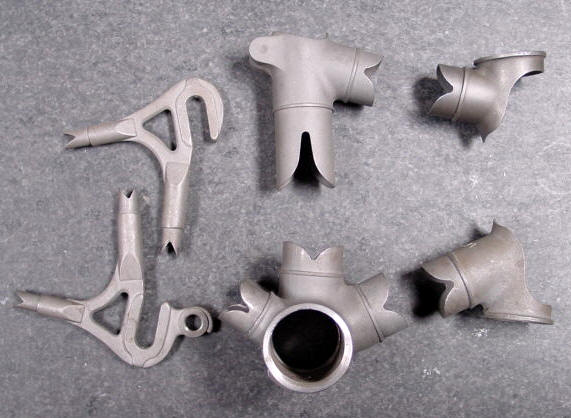
I worked at the very start with Faliero in setting up the Carlsbad operation. The original intention was to train American frame builders but it soon became apparent that this could not be achieved in a short time frame. So, we brought 3 Italian frame builders who had built for Masi in Italy. After the factory was up and running, the only Italian builder who stayed in the US was Mario Confente. One of the first major innovations that came out of our U. S. frame shop was the fully investment cast lugs.

We sent Mario to Microfusione in Italy to have our original idea of investment cast lugs made. The Italian company, Microfusione, was not able to produce the lugs without the help of its US licensee who had the expertise to produce the thin walled technology. Mario advised that the lugs not be made in Italy since the ideas would most likely be copied by other Italian companies. His prediction soon came true as our $80,000 investment in developing the tooling to produce the lugs was soon being used by other major Italian manufacturers. We were the first company to put into production the fully investment cast lugged tubed frame. Our pioneering efforts soon became the industry standard.

In 1975, Mario Confente went out on his own to build his bicycles under his own name. In 1979, Mario Confente asked to come back and work for Masi. In the process of setting up his shop with us, he passed away. In fact, the morning Mario died of a massive heart attack he was scheduled to meet Rene Moser, the general manager of Masi at the time, to go pick up a new granite surface plate. Back to 1976. In this year, Mike Howard built frames and Brian Baylis painted the Masi frames.

It was in 1977 that the Carlsbad factory began a transfer to the San Marcos, California facility. During that time Albert Eisentraut built about 50 frames to fill a gap during our move. Keith Lippy became a principal frame builder from 1977 to 1978. Rob Roberson also built our frames during this time. One of the special bikes that we made during this time required several pairs of forks. This of course was the now famous bike ridden in the Oscar nominated movie "Breaking Away."

In 1978, I took full control of Masi frame building. Jim Allen took charge of the painting operation. Also in 1978, Dave Moulton and I became the main frame builders. It was around 1984/1985 that Joe Starck replaced Moulton as one of the principal builders.

I continued to build special team frames and oversee that the qualities and traditions of the Masi frames were maintained. During the mid 1980s, I became the owner of the Masi trademark. This is just a brief history of Masi USA frame building. The information on your page regarding serial numbers while some of it is correct the majority of the information is erroneous. On our web site, www.masibikes.com, we intend to produce more details and we will keep you posted.

With regard to the Italian Masi page. I would like to clear up a few errors. First of all, there were no "nefarious business dealings" on our part in acquiring the Masi trademark. Faliero Masi was paid $175,000 for the trademark, plus he was paid a salary to oversee the running of the operation and a royalty for every frame that was made. In today's dollars that would probably be a million dollar deal. In fact, the nefarious business dealings came from Italy. During the final negotiations for the trademark deal with Faliero Masi, Alberto Masi tried to prevent the deal by claiming the trademark as his own. In the end, the deal was a huge compensation for all the years of hard work Faliero put in to building a reputation that we here in the United States have done well to live up to. Finally, with regard to the Lokoshinx (correct spelling) team that rode our bikes to World and Olympic gold medals, it was I who specially built their bikes not Masi Italy.

I hope this information is helpful in your efforts to keep accurate information about classic bicycles. In the future, I'd be happy to verify any information regarding Masi bicycles built since 1973. Thank you very much.

Regards,
Ted Kirkbride"

ICJ Reader contribution contest will run 1 January to 15 February, 2011. Details here.

Follow on Twitter: ITALIANCYCJOURN

Stories for the Italian Cycling Journal about rides, granfondos, having a good time cycling in Italy, Italian cycling history, etc. are very welcome. Contact me at veronaman@gmail.com. There are more than 1,600 stories in this blog. The search feature to the right works best for finding subjects in the blog. There is also an Italian weather widget along the right side and a translate button at the bottom so you can translate each page. What I'm riding.

Monday, August 9, 2010

Masi Protoype


This interesting Masi showed up on ebay this past week. The seller, in Zürich, Switzerland, described it as, "New Masi Gran Criterium frame, built by Masi's steel frame builder Giovanni Pelizzoli aka Ciocc (the real Ciocc - check out http://vimeo.com/5519990), who proposed me with this frame to distribute Alberto Masi frames in Europe. Although I ordered an original Gran Criterium, Giovanni invented it like this, it is a one of, a prototype for a "new" Gran Criterium.

The frame is built in Columbus Spirit tubing. Fully chromed. The steerer tube is too long: has to be cut and threaded or used with an ahead stem."

- Fully lugged and chromed
- BB Italian
- Top tube 56, seat tube 56 c-c

Note: Faliero Masi sold the rights to produce bikes under the Masi name in the US in the 1970s. The frames built by his son, Alberto Masi, are sold under the name "Milano". Alberto Masi built frames, in Milano, are available from importer Milano Sport located in Greenwich, CT.

The frame is sure to be a rare, one-off.

Stories for the Italian Cycling Journal about rides, granfondos, having a good time cycling in Italy, Italian cycling history, etc. are very welcome. Contact me at veronaman@gmail.com. There are more than 1,500 stories in this blog. The search feature to the right works best for finding subjects in the blog and there is also a translate button at the bottom so you can translate each page.

Tuesday, November 10, 2009

Golden Era Revealed Through An Open Door


The following article appeared in the United Kingdom's GUARDIAN newspaper:


A golden era of cycling revealed through an open door

Milan's Velodromo Vigorelli may now be almost derelict but to the trained eye it still houses some of cycling's greatest memories

Bathed in autumn sunlight, the Velodromo Comunale Vigorelli looks much as it must have done in 1935: a monument to the rakish optimism of futurist architecture. Standing in the north-western suburbs of Milan, not far from the elegant Ippodromo and the majestic San Siro, this compact arena breathes history – and not just that of cycling, since the Beatles played here to a full house of 10,000 screaming Italian fans in the summer of 1965.

It is for its original purpose, however, that the Vigorelli claims a place in legend. Here, on a 400m wooden track, is where Fausto Coppi, Jacques Anquetil and half a dozen two-wheeled heroes set new world records for the distance covered in one hour, which used to be among the sport's great tests. This, too, is where Coppi entered in triumph at the conclusion of one of his victories in the Giro d'Italia.

It is some time, however, since any cyclist, great or unknown, passed through the little door marked "Ingresso atleti". Nowaday the players and opponents of the city's American football club are the stadium's sole tenants and only an uneasy conscience keeps the municipality from tearing down an edifice that was rebuilt in 1945 after Allied firebombs had destroyed the original track.

On this beautiful afternoon the Vigorelli is sternly padlocked at every official entrance, with no caretaker in sight. One doorway, however, is open. And inside, the whole place comes alive.

Bicycles and wheels are hanging from ceiling-mounted racks. Clusters of lightweight steel tubes protrude from shelves. A set of vintage Campagnolo tools nestles in a fitted wooden box, the maker's name engraved in flowing script on its lid, several decades old but ready for daily use.

Alberto Masi, 65 years old, is the man who handles these tools. His father, Faliero Masi, set up this atelier in 1949, quickly establishing such a reputation for quality that leading riders paid him to make frames which were then painted in the colours of the manufacturers to whom they were contracted.

Faliero moved to California in the 1970s, selling the rights to produce bikes under the Masi name in the US before returning home a few years later. He died in 2000, aged 93. Alberto, who learned the craft at his father's knee, now produces a small number of new hand-built frames and spends the rest of his time restoring the classics his father built.

Here, he says, are some of his current projects. This is a Faema-badged machine ridden by the incomparable Eddy Merckx. Here is a Gazelle that belonged to another great Belgian rider Rik van Looy. And there, leaning against the wall in a back room, is a tandem painted in the Bianchi company's trademark sky-blue colour, ridden to a gold medal in the 1948 Olympics at London's Herne Hill track by Renato Perona and Ferdinando Teruzzi, ahead of the British pair of Alan Bannister and Reg Harris.

"Ah, Harris," Alberto Masi exclaims. "Grande campione!" And a friend of the family, he adds, as was Tom Simpson, whose Peugeot bikes were actually Masis in disguise.

Alberto goes up a stepladder to a loft and re-emerges holding a copy of a letter. It's addressed to his father, written from Buenos Aires in 1958 by Fausto Coppi, ordering new frames in time for the Giro d'Italia.

He points up at a corner of the ceiling. There, hanging from a rack, are two welded steel assemblies, in the shape of bike frames, dusty and discoloured. They are, he says, the jigs from which his father made Coppi's bespoke machines: one for road racing, the other for tracks like the Vigorelli, unused since Coppi's death in 1960. Honestly, if you'd taken me to the convent of Santa Maria delle Grazie in the centre of Milan and shown me the brushes with which Leonardo painted The Last Supper, I couldn't have been more impressed. Sometimes history is just the other side of an open door.

Photo accompanying article: The Italian Ercole Baldini rides at Milan's Vigorelli velodrome in 1956, AFP/Getty Images

ed: note: use the search button along the right side to find many articles about the Vigorelli velodrome and Masi, especially this one about future plans for the Vigorelli

Stories for the Italian Cycling Journal welcome; contact me at veronaman@gmail.com. There are more than 1,000 stories in this blog; the search feature to the right works best for finding subjects in the blog.

Monday, July 27, 2009

MASI Identification: American Or Italian?


A friend of mine, Bob Hovey, has a great site (www.bhovey.com/Masi/index.html) that contains several very interesting and useful articles about MASI bicycles. The following article (last updated 2006), and photographs above, are used by permission.

Italian or American?
This should be such an easy question, but it isn't...

Let's begin by asking a another question: If an Italian builder moves to the US, begins producing his Italian bike design and outfits it with all-Italian components (except for a set of American Hunt-Wilde handlebar plugs), is it Italian or American? Let's ask another question: If the tubes are brazed in Italy and the frame is imported into the USA unpainted, then it is numbered, painted, decaled, built up and sold by Masi USA, is it an Italian bike or an American one?

Whether a bike is an Italian or an American Masi is a more complex matter than knowing the country where the frame was brazed. Most often, the guiding factor is the nationality of the parent company that is selling the frame. For example, Masi USA had several models built in Italy under subcontract (not by Alberto Masi), and while that might appear to make them American bikes in name only, anyone familiar with Alberto's work would certainly deny that these bikes are Italian Masis. So what are they? These days, we seem to be able to accept the idea of US and European branded bikes built in Taiwan or China, but back in the days of lugged steel it was not an unreasonable assumption that a bike would be built in the country of origin. Masi may have been one of the first well-known instances where this was not to be so and even today the matter causes much confusion.

Perhaps we should begin with the easy cases. If you own a Masi from 1972 or earlier (this would be an early Gran Criterium, Masi Special strada or pista, or a Masi Speciale Corsa) then it is Italian, end of story. If you like Masi bikes and the whole mystique of Faliero "The Tailor" Masi and the tiny shop under the Vigorelli, and you are annoyed by any trace of ambiguity, then these are the bikes for you (OK, so some of the Gran Criteriums were subcontracted to other builders, but they were all Italian and from shops in northern Italy where Faliero could keep an eye on production quality).

In 1973, Masi production began in the US, first under the guidance of Faliero Masi, later under Mario Confente. These bikes began as nearly identical reproductions of the Italian twin-plate Gran Criteriums that were being produced in Italy at the time, but while the Italian models only have a frame size stamped on the bottom bracket (with a one or two letter prefix) and perhaps a matching size stamp and date stamp on the steering tube, the US Masis were serial numbered with only a small handful of exceptions. So here's another easy case: If you find yourself in possession of a Gran Criterium with both a frame size stamp (prefix A, MC, SMC or M) and a serial number, then it is a US-built Masi. The serial number could be two, three or four digits or four digits with an A-D prefix. For more specific information on Masi USA serial numbers, go here.

The third easy case is that of the Masi Prestige. This one is all-Italian. No argument there. The Prestige was Alberto Masi's baby, and was not legally sold in the US (except by rare special order thru High Country Imports for a very few years in the 80's). We should note here that Alberto did market a few of his own bikes (mostly Prestiges and 3V's) in the US under the "Milano" name, a practice that still continues. Probably identical to their Italian counterparts, the Masi name was often not seen anywhere on the bike, not even Alberto's small signature on the top tube.

Another easy call: If your bike is a Team 3V, it is American. But not necessarily American built... it may have been built elsewhere under subcontract (probably by Billato or Mondonico), but it is considered a US bike.

The same goes for the Gran Corsa and Nuova Strada... they were US bikes, but were never built here. They were built in Italy (again, probably by Billato or Mondonico), imported as bare frames, then numbered, painted and decaled here by Jim Allen.

Finally, if it is a Gran Criterium built after 1978, it is American (many people are under the impression that the Italian Gran Criterium was quickly phased out following the introduction of the Prestige in 1974, but they were actually built in limited numbers and sold in Europe until at least 1978). Again, the American Gran Criterium's origin will be confirmed by a four digit (or four digit with an A-D prefix) serial number, in addition to the frame size stamp.

After 1974, most Italian Masi Prestiges, Gran Criteriums and 3V's had two or three digit date codes (two digit year followed by one or two digit month). Some time in the 90's I believe the year and month were reversed and sometimes a day was added as well (so in this case the date code might contain as many as six digits). These date codes are usually recognizable because they were done with a smaller size stamp than the frame size stamp. Some 80's Italian bikes, mostly 3V's, do occasionally turn up with serial numbers. They are usually three digits and are in the larger sized stamp that was used to stamp the frame size. These bikes are immediately recognizable as they are about the only Masis with three sets of numbers. There is one other instance of a third number appearing on Italian Masis, most often one, but occasionally two digits. This stamp is said to be a repaint number, applied when one took the frame back to Alberto for a respray. The number is usually located on the lower drive side chainstay tang of the bottom bracket, but once in a while it is seen on the BB shell itself below the date code or frame size stamps.

The 3V (Tre Volumetrica) began as Alberto's design and the first ones were probably built at the Vigorelli until sales began to outpace the capabilities of the small shop, at which time production probably moved to (or was augmented by) one or more subcontrators. The bike's growing popularity began to be felt in the US as well, but Alberto was still bound by the agreement that his father had made in 1973 (that Masi USA would retain all rights to the Masi name). But here was a bike design that was popular enough to potentially heal the rift, or to at least open the door to allow Alberto's bikes back into the US. Around 1983 or 1984, Alberto and Masi Worldwide struck a deal to allow the 3V to be sold in America. It is these mid-'80's 3V's that are probably the hardest to differentiate as being American or Italian. Sometimes there will be red, white and blue banner stripes (or US flag banner) on the seat tube (see the seat tube page of "Masi Bits") but the earliest bikes sold by Masi USA in the mid 80's looked exactly like the Italian ones. That's because at this point in Masi USA's sales agreement with Alberto, these were the same bikes from the same builder and had the same paint (often a pearl or opalescent topcoat) and decals. It is these 3V's that stretch our basic premise (that the nationality of the bike is considered to be that of the company selling it) to the breaking point... here we have two bikes, one (supposedly) American and one Italian, that are for all practical purposes identical with no real way to tell them apart. Any reasonable person would consider both bikes Italian, but some might argue that technically (or legally) they were different products.

Around 1987, 3V production began in the US and these 3V's are more easily recognized by Jim Allen's Imron paint and the Campagnolo dropouts (the Italian 3V dropouts were proprietary and socketed, like the lugs) as well as the Henry James crown. Alberto's 3V's and the earlier US-marketed 3V's had Alberto's slot-shouldered crown.

By the mid 90's most of the American 3V, Team 3V and Gran Criterium production went to Italian subcontractors (though a few custom orders continued to be built here, probably by Ted Kirkbride) so as with the Gran Corsa and Nuova Strada, we have a case of Italian frames that were sold as American. Some of the Team 3V's were painted in Italy with a few basic colors, but the greater majority of these frames were painted and decaled here by Jim Allen.

A recent appearance of Alberto's Italian Masi in the US is the model Nuovo Prestige. This bike is brazed in Italy (with Richard Sachs' Richie-issimo lugs and a Duomo symbol on the fork crown flats), and imported painted or unpainted. They've been spotted here with "Alberto Masi" downtube decals and a "3V" head tube and seat tube badge (3V in this case refers not to the bike model but a more generic reference: "La Vera Volumetrica del Vigorelli," meaning "The true Volumetrica from the Vigorelli."

These days, it is probably easier than ever to distinguish the American Masis from the Italian ones. Their logos and graphics are completely different and Alberto does not seem to be a big fan of sloping top tubes which the American bikes use almost exclusively. As for where these new Italian and American Masis are actually built... well, we'll leave that for another day.

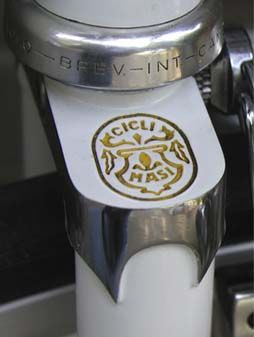
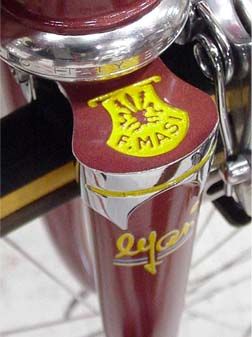
Photos: a few of the Masi headbadge photos in Bob's collection, see http://bhovey.com/Masi/MasiBits/Head.htm

Search within blog for "Masi" for more photos and stories. Stories, including cycling trip stories, for the Italian Cycling Journal welcome; contact veronaman@gmail.com

Thursday, July 9, 2009

MASI Lore: A Collection Point for MASI History


An interesting collection of MASI dating information, brochures, and interviews has been collected at "MASI LORE" (http://masi.gregfletcher.net/).


The author writes, "If you can contribute anything to Masi lore, an anecdote, a story, a copy of a Masi brochure, or just a photo of your Masi (any year and type is fine), let me know and I'll add it to the collection of stuff. After all, what good is the internet if you can't share some cool information?"


Stories, including cycling trip stories, for the Italian Cycling Journal welcome; contact veronaman@gmail.com

Monday, June 15, 2009

Eddy Merckx Not Riding An Eddy Merckx


Until the other day I had never seen a photograph of Eddy Merckx not riding anything other than an Eddy Merckx labeled bike. Eddy Merckx was obviously very special, including having the ability to demand that his name be on the bikes (De Rosa, Colnago and Masi among others) that he rode. Think about that in the context of today's peloton.


So, while reading "Un Secolo di Passioni"(http://italiancyclingjournal.blogspot.com/2009/04/book-un-secolo-di-passioni.html) I was surprised to see a photo of Eddy Merckx riding a FAEMA branded bike. The only time this occurred was apparently in 1968 and the caption on the photograph in the book is, "Gorizia-Tre Cime di Lavaredo stage". This frame was made by Masi; you can see the outline of the Duomo of Milano above the F on the head tube.

FAEMA (Fabbrica Apparecchiature Elettromeccaniche e Affini) was an espresso machine manufacturer. Although known for its innovations in espresso machine technology, among cyclists FAEMA is better known as the team that Eddy Merckx rode for.


Photos: B&W: photos of photo in Un Secolo di Passioni; color photo from Kevin Sayles. If you have another photo of Eddy Merckx riding a FAEMA bike please contact me.
Here also is a photo of Vittorio Adorni riding a FAEMA Masi:


Stories, including cycling trip stories, for the Italian Cycling Journal welcome; contact veronaman@gmail.com

Tuesday, April 7, 2009

Velodromo Vigorelli, via Arona 19, Milano; Part II


In Part I (http://italiancyclingjournal.blogspot.com/2007/12/velodromo-vigorelli-via-arona-19-milano.html), back in December, 2007, we discussed a proposal that was presented to the Mayor of Milano for a new multi-use Vigorelli.


The specific project plans have now been unveiled and the next step in the project is to seek financing. The city is committed to funding 12 million Euro of the estimated 50 million Euro project cost; the other 38 million Euro would come from the private sector. The goal is to inaugurate the new facility in 2012.


The main elements of the plan are:
-the exterior is unchanged,
-installation of a transparent bubble roof (photo above)
-new track of 250 meters in length (in order to comply with World Championship regulations; when the Vigorelli was built in 1935 it was 397.57 meters in length),
-permanent seating expanded from 9,000 to 10,000 seats,
-in addition to permanent seating there will be 2,000 track-side seats for track events,
-quick re-configuration of the facility for sporting events (such as basketball, hockey and boxing) and concerts,
-22 box suites

Take a look at the video of the future for the Vigorelli:


Tomorrow we'll discuss what this all signifies for Alberto Masi who has continued in his father's (Faliero) shop at the Vigorelli.


Stories for the Italian Cycling Journal welcome; contact veronaman@gmail.