Showing posts with label Milan-Sanremo. Show all posts
Friday, February 1, 2013
Riding the Milan-Sanremo Route
Larry, from CycleItalia, writes in with information of a special tour they have planned for this year:
"One of my life goals is to see all five of cycling's monuments, Milano-San Remo (MSR), Paris-Roubaix, Tour of Flanders, Liege-Bastogne-Liege and Tour of Lombardy. We started at the beginning in 2010 with MSR, seeing the race pass by atop the Poggio after riding our own bikes down from San Remo to pick up the course on the Cipressa.
I've remained fascinated by MSR ever since we drove a lot of the course in the car the day prior to the big race. In 2012 we thought some others might want to join us as we retraced the famous route so our "La Primavera" tour was born.
We skip the chaos of Milan and the historic Duomo, instead picking up the course from our Italian HQ in Monferrato. We intersect the route in Novi Ligure, then take a detour to Castellania so we can pay our respects to Il Campionissimo Fausto Coppi and later visit the Museum of Champions.We pick up the route again at the base of the mythical Passo Turchino, not such a tough climb these days with smooth pavement, but you do get an idea of what this must have been like 100 years ago and the experience of emerging from the tunnel into the Ligurian sunshine remains a stirring experience, as does the descent!
Once on the coast roads we follow the route, including the recent "detour" up the Manie climb and spend a night just over the summit with a spectacular view of the coast while enjoying a feast in a Slowfood ristorante at our hotel. Our final ride takes us over the famous Capi, then the Cipressa, Poggio and final run-in to San Remo."
May 14-21, 2013. Limited to just SEVEN participants. 8 days/6 hotel nights. More details and pricing at www.cycleitalia.com
Follow on Twitter: ITALIANCYCJOURN or receive an email when new content is added using the "Follow by Email" button on the right side column.
Stories for the Italian Cycling Journal about rides, granfondos, touring, having a good time cycling in Italy, Italian cycling history, racing, etc. are always welcome. Contact me at veronaman@gmail.com. There are now more than 2,700 stories in this blog. The search feature to the right works best for finding subjects in the blog. There is also a translate button at the bottom so you can translate each page.
Thursday, July 5, 2012
Clarified: The Future of Tirreno-Adriatico, Milan-Sanremo and Il Lombardia
The statements made by Michele Acquarone, Managing Director at RCS Sport, that were quoted in the Dutch De Telegraaf newspaper have been clarified by Acquarone. "My friends of the Telegraaf have exaggerated my thoughts but the substance of what they have written is correct. My comments were much wider than what was reported and which covered the problem of overcrowding on the racing calendar, and the overlap of important races. For example, Paris-Nice and Tirreno-Adriatico. But, I want to add that Tirreno-Adriatico is a flagship event for RCS Sport and our aim is to give it the right visibility. For years we have a cast that is better than Paris-Nice but we have to collide with the force of ASO (the Tour de France organizer) and the contracts that are "imposed" on broadcasters. We are not so powerful but with the new agreement signed with IMG we hope to move forward. We cannot sit still and suffer forever. "
Acquarone continued regarding moving Milan-Sanremo and Il Lombardia to Sundays rather then the Saturdays when they are held now, "There are those who are studying the problem to ensure that our races are seen by all. Our intent is to further enhance our great heritage, not wasting it."
"The future is now," continued Acquarone. "The UCI has already opened discussions to study how to solve the problem of the calendar and it has already held a first meeting in Paris which was attended by Mauro Vegni. And I'm sure we can reach a good solution for the UCI, for RCS Sport and cycling. These are my thoughts: the Telegraaf exaggerated some comments but I want to be clear that Tirreno-Adriatico, Milan-Sanremo and Il Lombardia will not be touched other than on the calendar."
Follow on Twitter: ITALIANCYCJOURN
Stories for the Italian Cycling Journal about rides, granfondos, touring, having a good time cycling in Italy, Italian cycling history, etc. are always welcome. Contact me at veronaman@gmail.com. There are more than 2,500 stories in this blog. The search feature to the right works best for finding subjects in the blog. There is also a translate button at the bottom so you can translate each page .
Acquarone continued regarding moving Milan-Sanremo and Il Lombardia to Sundays rather then the Saturdays when they are held now, "There are those who are studying the problem to ensure that our races are seen by all. Our intent is to further enhance our great heritage, not wasting it."
"The future is now," continued Acquarone. "The UCI has already opened discussions to study how to solve the problem of the calendar and it has already held a first meeting in Paris which was attended by Mauro Vegni. And I'm sure we can reach a good solution for the UCI, for RCS Sport and cycling. These are my thoughts: the Telegraaf exaggerated some comments but I want to be clear that Tirreno-Adriatico, Milan-Sanremo and Il Lombardia will not be touched other than on the calendar."
Follow on Twitter: ITALIANCYCJOURN
Stories for the Italian Cycling Journal about rides, granfondos, touring, having a good time cycling in Italy, Italian cycling history, etc. are always welcome. Contact me at veronaman@gmail.com. There are more than 2,500 stories in this blog. The search feature to the right works best for finding subjects in the blog. There is also a translate button at the bottom so you can translate each page .
Thursday, March 17, 2011
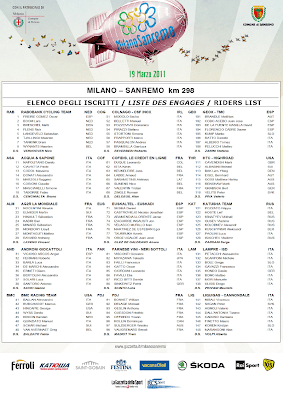
2011 Milan-Sanremo Start List & Numbers

Click on images to enlarge.
Alessandro Petacchi, who won in 2005, has been suffering during the last few days from a bad cold and asthma attacks putting his start in jeopardy. However, he managed a 4 hour training ride today and communicated to team doctor Beltemacchi that he had no coughing fits and no asthma attacks. His cold symptoms are still quite strong but he attends to be at the start with team mates Bole, Bono, Gavazzi, Hondo, Mori, Scarponi and Ulissi.
The 298 Km classic, one of the "monuments", is Saturday.
Follow on Twitter: ITALIANCYCJOURN
Stories for the Italian Cycling Journal about rides, granfondos, having a good time cycling in Italy, Italian cycling history, etc. are always welcome. Contact me at veronaman@gmail.com. There are more than 1,800 stories in this blog. The search feature to the right works best for finding subjects in the blog. There is also a translate button at the bottom so you can translate each page. What I'm riding.
Saturday, March 20, 2010
Descent of Milan-Sanremo's Cipressa
Courtesy of http://michaelbarry.ca/:
"My teammate Juan Antonio Flecha filmed the descent off the Cipressa with a helmet camera while we were out pre-riding the race course. The Cipressa and the Poggio are the two decisive climbs in Milan Sanremo where the descents are as important as the ascents as position and a rider’s ability to handle his bike often determine the outcome of the race.
Yearly, a rider crashes in the one of the numerous hairpin turns coming off the climb. The road surface is smooth and the climbs are in the final hour of the race so the speed will be high. Every rider is tired and on his limit from the distance and the intensity of the race so errors are made and splits in the peloton occur. When the peloton reaches the coast road after the descent off the Cipressa the peloton will be in a long thin line and will often split near the back of the group as riders are unable to maintain the speed."
Stories for the Italian Cycling Journal about rides, granfondo, having a good time cycling in Italy, Italian cycling history, etc. are very welcome. Contact me at veronaman@gmail.com. There are more than 1,300 stories in this blog. The search feature to the right works best for finding subjects in the blog and there is also a translate button at the bottom so you can translate each page.
"My teammate Juan Antonio Flecha filmed the descent off the Cipressa with a helmet camera while we were out pre-riding the race course. The Cipressa and the Poggio are the two decisive climbs in Milan Sanremo where the descents are as important as the ascents as position and a rider’s ability to handle his bike often determine the outcome of the race.
Yearly, a rider crashes in the one of the numerous hairpin turns coming off the climb. The road surface is smooth and the climbs are in the final hour of the race so the speed will be high. Every rider is tired and on his limit from the distance and the intensity of the race so errors are made and splits in the peloton occur. When the peloton reaches the coast road after the descent off the Cipressa the peloton will be in a long thin line and will often split near the back of the group as riders are unable to maintain the speed."
Stories for the Italian Cycling Journal about rides, granfondo, having a good time cycling in Italy, Italian cycling history, etc. are very welcome. Contact me at veronaman@gmail.com. There are more than 1,300 stories in this blog. The search feature to the right works best for finding subjects in the blog and there is also a translate button at the bottom so you can translate each page.
Oscar Freire Wins His 3rd Milan-Sanremo

Escapes were attempted but once again it came to a sprint finish. As reported by the Gazzetta dello Sport:
"Oscar Freire is like that: he wins when you don't expect him to. Sometimes, as was the case in the Classicissima number 101, he dominates - without the help of his team, without giving his rivals the chance to respond to that one, lethal, strike. The Spanish Rabobank rider convincingly won the contest with Tom Boonen, second, and Alessandro Petacchi, third. And following his wins in 2004 and 2007, the third Milan-San Remo - the same number Fausto Coppi won - now gleams brightly in an amazing trophy cabinet, which already holds 3 world titles.
THE SPRINT — The victory tally again stands in favour of foreign riders: 51-50, including the last four. And yet our riders all had their moments: Francesco Ginanni on the descent from the Cipressa, Vincenzo Nibali coming down the Poggio, Filippo Pozzato with a counter-attack after Gilbert's charge in the final 10 km of the race. And Petacchi held off the attacks on the San Remo's final climb, which yet again did not prove to be decisive. But there was nothing that could be done about the sprint. Freire stayed on Bennati's wheel, guided by Kreuziger; Boonen and Petacchi were behind him. When Oscarito got up on his pedals, the Liquigas-Domino rider Bennati stayed put (he finished fifth). Petacchi? Left behind. And it was Freire relatively easily, with Modolo, the first-year professional with CSF-Colnago, an excellent fourth. Boasson Hagen and Cavendish (puncture on the Turchino) were among the day's disappointed riders. Cunego, our hope for the northern classics, had a good race.
THE START — The day began with an extended break by Ratti, Caccia and Piemontesi, who got away after 1 km and built up a lead of more than 20 minutes; that was followed by the Brazilian rider Fischer falling on the decsent from the Turchino, which forced him to retire with a broken collar-bone, and the attack by the Bouet-Grabovskyy duo on Capo Berta. A taste of what was to come on Cipressa.
A RELAXED PETACCHI — "Winning the San Remo is always important, but this is the third...," said Freire. "I'm going really well this year (this was his fourth win, ed.), and I hope I can keep it up. I dedicate this victory to my team: I was the only one who had won it twice, but no one thought of me as a favourite. We'll see if I'm among the favourites next year." Petacchi was relaxed: "I rode a great San Remo. I was amazed how well I went on the Poggio. I knew Gilbert and Pozzato would take off, so I tried to stay with them and I didn't realise there was a gap behind us. Then on the descent I tried to stay in front to avoid any risks." Pozzato: "We had already decided that if things didn't go well on the Poggio, I would try to make a move in the last two kilometres. Congratulations to Oscar." Boonen: "Freire was great. I was also going well, I was on his wheel and I tried to anticipate him, but Oscar won by two bike lengths. After a sprint like that you can only say that Oscar was the best."
Stories for the Italian Cycling Journal about rides, granfondo, having a good time cycling in Italy, Italian cycling history, etc. are very welcome. Contact me at veronaman@gmail.com. There are more than 1,300 stories in this blog. The search feature to the right works best for finding subjects in the blog and there is also a translate button at the bottom so you can translate each page.
Friday, March 19, 2010
Milano-San Remo Down Through The Years

This article is written and contributed by Mark Mahan.
Milano- San Remo Down Through The Years
La Classicissima or La Primavera, Milano-San Remo is the first big appointment on the year’s racing calendar and tomorrow’s race promises as always to be electrifying. Being the lottery that is however, the prognosticators have been plying us for days now with the eternal question; will it come down to a sprint or will a break get away on one of the famous “Capi” or sharp little climbs that dot the final 40 kilometres?
Tomorrow’s edition is the 101st and the sprint versus the breakaway has been a theme at Milano San Remo from the very beginning. It wasn’t until the 4th running of the race in 1910 that a significant gap was recorded between first and second place, a full 61 minutes. Eugene Christophe won one of the more dramatic editions due to horrendous weather, his winning time was 12 hrs. 24’minutes. In 1917 Tano Belloni, the first racer to be called “The Eternal Second” won, beating the first “Campionissimo” Costante Giradengo. Belloni attacked alone in the town of Ovada, 166 km. from the finish, again in awful weather conditions. Giradengo arrived 11’48” later, a half an hour in front of the third place rider. The very next year, 1918, the roles were reversed, this time it was Giradengo who attacked from even further out. Wouldn’t you know it, in atrocious weather, that made the dirt roads muddy paths. Belloni chased alone, arriving 13’14” behind “Il Gira” with third place coming in at 59’ minutes. Only seven riders finished the race, the last place came in at 10:00 PM, four hours later.
The Milano -San Remo of 1946 was much more than just a bike race. It was virtually synonymous with the re-birth of Italy after the end of the WWII, the expectations and agonistic tension were off the charts. Professional racing had more or less ceased after Fausto Coppi set the new hour record at Milano’s Vigorelli velodrome just before heading off to war in 1940. That was the same year he won the Giro d’Italia in his first time out, as Gino Bartali’s “gregario” or domestique. After the war ended Coppi paid a visit to the Legnano team in an attempt to get his job back, the door was closed though, the team deciding to opt for Bartali who was an established champion. The Bianchi team chose to gamble on the younger racer, giving him a handsome contract, the contents of which somehow made it back to the ears of Bartali who demanded the same treatment from his team, Legnano. They turned a deaf ear to Gino’s pleas. And that brings us to the start of the 1946 Milano- San Remo.
Coppi knew he had to make a bigger than life impression. He also knew that he wouldn’t be on equal footing with Bartali if it came down to a sprint finish. With that in mind he trained like an obsessed monk the entire winter, accumulating over 7000 kilometres before lining up at the starting line in Milano. Over 2000 of those kilometres were ridden on a fixed gear bike, something that was unheard of at the time. He had told his brother Serse, also on the Bianchi team, that his job was to cover Bartali and make sure that he didn’t chase him down. Little did Serse know that Fausto was going to attack almost from the gun, going off with a group of no names at the town of Binasco, just 10 km. into the race. But they were riding for glory and behind them all eyes were on Bartali who was seemingly disinterested in Coppi’s attack. Which takes us back to the contract dispute, Gino was riding the race so as not to infringe on his contractual obligations to his team but he wasn’t racing, he was simply riding.
By the start of the Turchino climb, freshly re-opened from the war closure, Coppi had ridden everyone off his wheel except for the French rider Lucien Teisseire. By the top of the climb Coppi was alone, the solo escape, which was to become his trademark for the next 15 years, began that day. His lead increased inexorably as he proceeded up the coast towards San Remo, his fluid, powerful pedal stroke never faltering. By the time he crossed the finish line his lead had grown to 14 minutes over Teisseire, Bartali rolled across 24 minutes later, his face a dark mask. Their rivalry had initiated in earnest that day and wasn’t due to end for many years to come, to the infinite delight of Italian cycling fans.
In so-called modern times really only two important attacks from a long way out have succeeded at Milano-San Remo. That of Gianni Bugno in 1990 and then the following year by Claudio Chiappucci. In the edition won by Bugno the first selection was created after just 20 km. by a strong wind that broke the peleton into three groups, Bugno being in the lead one. By km. 44 the first two groups had come together but behind a whole slew of big names were riding their eyes out trying to catch, amongst them was defending winner Laurent Fignon, going for the hat trick at MSR. The front group was on the boil, driving a furious pace that never seemed to drop below 45-46 km. per hour. Their lead increased despite the determined chase from behind, by km 168 it had ballooned to 11 minutes and at the town of Varazze 80 riders abandonded including Fignon. Up front the lead group had dwindled, casualties of the furious pace setting dropping off the back. Flying through the town of Imperia at km. 261 a Sicilian rider named Canzonieri attacked off the front, Bugno was the only one to follow him. Working smoothly together their lead grew to 41 seconds over a chase group that included Argentin, Skibby, Golz, Sorensen, Mottet and Fondriest. Heading into the “Capi”, those leg burning final climbs along the coast, Bugno decided to rid himself of his companion, dropping to a lower gear and jumping away decisively. By the top of the Cipressa his lead over Golz and Skibby was 18”, it was 28” over Delion, Fondriest and Colotti with what was left of the main group at 43”. At km 278 Bugno’s lead was 12” over the six men who had joined forces in the chase, the group at 34”, the race was still wide open. On the final climb of the Poggio, Bugno was still looking strong as behind him Rolf Golz surged, dropping his partner in the chase Jesper Skibby, passing over the top of the Poggio 15” in arrears. Both riders flew down the descent risking at every hairpin turn, Bugno floating just out of reach as he made it onto the flat run in to the finish where he won with his hands raised in the air, the classic Bugno victory salute. It wasn’t the last time that Gianni would have his “tifosi’s” hearts in their throats, hoping against all odds that their man would hang on for the win.
The very next year it was Claudio Chiappucci’s turn and his daring attack on the descent of a fog laden, rain soaked Passo Turchino blew the race wide open. His move had been planned much earlier and by taking powerful teammate Guido Bontempi with him, Chiappucci assured himself of better than even odds at staying away. Joining the two Carrera men were Marino Lajarreta, Charley Mottet, Rolf Sorensen and Adri Van de Poel. By the time the rest of the pack realized that Chiappucci was up the road their lead had grown to 40 seconds. There were just over 100 km. to the finish. Giving an idea of the pace being set, it took three flat lander rolleurs like Jelle Nijdam, Peter Stevenhagen and Thierry Marie 45 minutes to bridge up to the breakaway. Once this trio had hitched their cars to the train the race was on for real. As they rolled over the Capi the speed, the weather the fatigue began to take a toll and one by one, riders in the break began to slip off the back, Chiappucci driving it to keep the pace high. By the time the two remaining breakaways, Chiappucci and Sorensen, had reached the foot of the final climb up the Poggio, their lead over the pack was 1’40” and they knew that one of them was going to win. Knowing that he had no chance against the faster Dane in a sprint finish, Chiappucci attacked with everything he had left going up the Poggio, dropping Sorensen and just managed to negotiate his way down the other side without crashing. His solo win in Corso Cavallotti after a daring attack from far out propelled him into the hearts of the Italian tifoseria.
And now, in just a few more hours, the race caravan will begin the march towards San Remo and a new Classics’ season. Maybe it’s the romantic in me but I’d like to see a daring attack from a far, like in bygone years. Soon we’ll know.
Photo: Coppi winning the 1946 Milan-San Remo
Stories for the Italian Cycling Journal about rides, granfondo, having a good time cycling in Italy, Italian cycling history, etc. are very welcome. Contact me at veronaman@gmail.com. There are more than 1,300 stories in this blog. The search feature to the right works best for finding subjects in the blog and there is also a translate button at the bottom so you can translate each page.
Milano- San Remo Down Through The Years
La Classicissima or La Primavera, Milano-San Remo is the first big appointment on the year’s racing calendar and tomorrow’s race promises as always to be electrifying. Being the lottery that is however, the prognosticators have been plying us for days now with the eternal question; will it come down to a sprint or will a break get away on one of the famous “Capi” or sharp little climbs that dot the final 40 kilometres?
Tomorrow’s edition is the 101st and the sprint versus the breakaway has been a theme at Milano San Remo from the very beginning. It wasn’t until the 4th running of the race in 1910 that a significant gap was recorded between first and second place, a full 61 minutes. Eugene Christophe won one of the more dramatic editions due to horrendous weather, his winning time was 12 hrs. 24’minutes. In 1917 Tano Belloni, the first racer to be called “The Eternal Second” won, beating the first “Campionissimo” Costante Giradengo. Belloni attacked alone in the town of Ovada, 166 km. from the finish, again in awful weather conditions. Giradengo arrived 11’48” later, a half an hour in front of the third place rider. The very next year, 1918, the roles were reversed, this time it was Giradengo who attacked from even further out. Wouldn’t you know it, in atrocious weather, that made the dirt roads muddy paths. Belloni chased alone, arriving 13’14” behind “Il Gira” with third place coming in at 59’ minutes. Only seven riders finished the race, the last place came in at 10:00 PM, four hours later.
The Milano -San Remo of 1946 was much more than just a bike race. It was virtually synonymous with the re-birth of Italy after the end of the WWII, the expectations and agonistic tension were off the charts. Professional racing had more or less ceased after Fausto Coppi set the new hour record at Milano’s Vigorelli velodrome just before heading off to war in 1940. That was the same year he won the Giro d’Italia in his first time out, as Gino Bartali’s “gregario” or domestique. After the war ended Coppi paid a visit to the Legnano team in an attempt to get his job back, the door was closed though, the team deciding to opt for Bartali who was an established champion. The Bianchi team chose to gamble on the younger racer, giving him a handsome contract, the contents of which somehow made it back to the ears of Bartali who demanded the same treatment from his team, Legnano. They turned a deaf ear to Gino’s pleas. And that brings us to the start of the 1946 Milano- San Remo.
Coppi knew he had to make a bigger than life impression. He also knew that he wouldn’t be on equal footing with Bartali if it came down to a sprint finish. With that in mind he trained like an obsessed monk the entire winter, accumulating over 7000 kilometres before lining up at the starting line in Milano. Over 2000 of those kilometres were ridden on a fixed gear bike, something that was unheard of at the time. He had told his brother Serse, also on the Bianchi team, that his job was to cover Bartali and make sure that he didn’t chase him down. Little did Serse know that Fausto was going to attack almost from the gun, going off with a group of no names at the town of Binasco, just 10 km. into the race. But they were riding for glory and behind them all eyes were on Bartali who was seemingly disinterested in Coppi’s attack. Which takes us back to the contract dispute, Gino was riding the race so as not to infringe on his contractual obligations to his team but he wasn’t racing, he was simply riding.
By the start of the Turchino climb, freshly re-opened from the war closure, Coppi had ridden everyone off his wheel except for the French rider Lucien Teisseire. By the top of the climb Coppi was alone, the solo escape, which was to become his trademark for the next 15 years, began that day. His lead increased inexorably as he proceeded up the coast towards San Remo, his fluid, powerful pedal stroke never faltering. By the time he crossed the finish line his lead had grown to 14 minutes over Teisseire, Bartali rolled across 24 minutes later, his face a dark mask. Their rivalry had initiated in earnest that day and wasn’t due to end for many years to come, to the infinite delight of Italian cycling fans.
In so-called modern times really only two important attacks from a long way out have succeeded at Milano-San Remo. That of Gianni Bugno in 1990 and then the following year by Claudio Chiappucci. In the edition won by Bugno the first selection was created after just 20 km. by a strong wind that broke the peleton into three groups, Bugno being in the lead one. By km. 44 the first two groups had come together but behind a whole slew of big names were riding their eyes out trying to catch, amongst them was defending winner Laurent Fignon, going for the hat trick at MSR. The front group was on the boil, driving a furious pace that never seemed to drop below 45-46 km. per hour. Their lead increased despite the determined chase from behind, by km 168 it had ballooned to 11 minutes and at the town of Varazze 80 riders abandonded including Fignon. Up front the lead group had dwindled, casualties of the furious pace setting dropping off the back. Flying through the town of Imperia at km. 261 a Sicilian rider named Canzonieri attacked off the front, Bugno was the only one to follow him. Working smoothly together their lead grew to 41 seconds over a chase group that included Argentin, Skibby, Golz, Sorensen, Mottet and Fondriest. Heading into the “Capi”, those leg burning final climbs along the coast, Bugno decided to rid himself of his companion, dropping to a lower gear and jumping away decisively. By the top of the Cipressa his lead over Golz and Skibby was 18”, it was 28” over Delion, Fondriest and Colotti with what was left of the main group at 43”. At km 278 Bugno’s lead was 12” over the six men who had joined forces in the chase, the group at 34”, the race was still wide open. On the final climb of the Poggio, Bugno was still looking strong as behind him Rolf Golz surged, dropping his partner in the chase Jesper Skibby, passing over the top of the Poggio 15” in arrears. Both riders flew down the descent risking at every hairpin turn, Bugno floating just out of reach as he made it onto the flat run in to the finish where he won with his hands raised in the air, the classic Bugno victory salute. It wasn’t the last time that Gianni would have his “tifosi’s” hearts in their throats, hoping against all odds that their man would hang on for the win.
The very next year it was Claudio Chiappucci’s turn and his daring attack on the descent of a fog laden, rain soaked Passo Turchino blew the race wide open. His move had been planned much earlier and by taking powerful teammate Guido Bontempi with him, Chiappucci assured himself of better than even odds at staying away. Joining the two Carrera men were Marino Lajarreta, Charley Mottet, Rolf Sorensen and Adri Van de Poel. By the time the rest of the pack realized that Chiappucci was up the road their lead had grown to 40 seconds. There were just over 100 km. to the finish. Giving an idea of the pace being set, it took three flat lander rolleurs like Jelle Nijdam, Peter Stevenhagen and Thierry Marie 45 minutes to bridge up to the breakaway. Once this trio had hitched their cars to the train the race was on for real. As they rolled over the Capi the speed, the weather the fatigue began to take a toll and one by one, riders in the break began to slip off the back, Chiappucci driving it to keep the pace high. By the time the two remaining breakaways, Chiappucci and Sorensen, had reached the foot of the final climb up the Poggio, their lead over the pack was 1’40” and they knew that one of them was going to win. Knowing that he had no chance against the faster Dane in a sprint finish, Chiappucci attacked with everything he had left going up the Poggio, dropping Sorensen and just managed to negotiate his way down the other side without crashing. His solo win in Corso Cavallotti after a daring attack from far out propelled him into the hearts of the Italian tifoseria.
And now, in just a few more hours, the race caravan will begin the march towards San Remo and a new Classics’ season. Maybe it’s the romantic in me but I’d like to see a daring attack from a far, like in bygone years. Soon we’ll know.
Photo: Coppi winning the 1946 Milan-San Remo
Stories for the Italian Cycling Journal about rides, granfondo, having a good time cycling in Italy, Italian cycling history, etc. are very welcome. Contact me at veronaman@gmail.com. There are more than 1,300 stories in this blog. The search feature to the right works best for finding subjects in the blog and there is also a translate button at the bottom so you can translate each page.
Favorites for 2010 Milan-San Remo

The 101st edition of Milan-Sanremo is tomorrow. For the 100 previous editions of the race the number of victories by Italians and foreigners stands at 50 each. Two hundred riders, representing 25 teams, will start hoping to write their names in the history books.
The Italian favorites are Petacchi, Pozzato, Cunego and Bennati. The foreign favorites are Boonen, Gilbert, Cancellara, Boasson Hagen and Freire. Outside favorites include the dueling Scarponi and Garzelli from the just concluded Tirreno-Adriatico, Visconti, Flecha, Farrar, Gerdemann and Cavendish (last year's winner who had health problems this year putting him behind schedule in his preparations). Lance Armstrong announced this morning that he will not start due to acute gastroenteritis.
Michele Dancelli will be present on the occasion of celebrating his 40th Milan-Sanremo anniversary victory from 1970. That year Dancelli was in a 200km escape and rode 70 km solo to victory.
Stories for the Italian Cycling Journal about rides, granfondo, having a good time cycling in Italy, Italian cycling history, etc. are very welcome. Contact me at veronaman@gmail.com. There are more than 1,300 stories in this blog. The search feature to the right works best for finding subjects in the blog and there is also a translate button at the bottom so you can translate each page.
Thursday, March 18, 2010
2010 Milan-Sanremo


We are at -2 days before the "Classicissima" (also "la classica di Primavera") , Milan-Sanremo, which will begin on Saturday from Castello Sforzesco in Milan and finishes 298 km (185 miles) later on the Lungomare Italo Calvino in Sanremo.
Last year was the 100th edition of the race which is one of the "monuments' of cycling. It is the longest one day race on the professional calendar and coming early in the season it is a true test of endurance.
The race will be broadcast in Europe by RAI and Europort. The USA is carrying it (perhaps delayed, best to check schedule) on the Universal Sports (US) channel. RAI will be streaming it from www.rai.it; you can also check at www.cyclingfans.com to pickup streaming links. Broadcasting is set to start, picking up the race nearer to the finish, at about 1450 Italy time.
Photos: Route information (click to enlarge)
Past winners (or how great is Eddy Merckx?)
1907 Petit Breton
1908 Vanhauwaert
1909 Ganna
1910 Christophe
1911 Garrigou
1912 Pelissier
1913 Defraye
1914 Agostoni
1915 Corlaita
1917 Belloni
1918 Girardengo
1919 Gremo
1920 Belloni
1921 Girardengo
1922 Brunero
1923 Girardengo
1924 Linari
1925 Girardengo
1926 Girardengo
1927 Chesi
1928 Girardengo
1929 Binda
1930 Mara M.
1931 Binda
1932 Bovet
1933 Guerra
1934 Demuysère
1935 Olmo
1936 Varetto
1937 Del Cancia
1938 Olmo
1939 Bartali
1940 Bartali
1941 Favalli
1942 Leoni
1943 Cinelli
1946 Coppi F.
1947 Bartali
1948 Coppi F.
1949 Coppi F.
1950 Bartali
1951 Bobet L.
1952 Petrucci
1953 Petrucci
1954 Van Steenbergen
1955 Derycke
1956 De Bruyne
1957 Poblet
1958 Van Looy
1959 Poblet
1960 Privat
1961 Poulidor
1962 Daems
1963 Groussard J.
1964 Simpson
1965 Den Hartog
1966 Merckx
1967 Merckx
1968 Altig
1969 Merckx
1970 Dancelli
1971 Merckx
1972 Merckx
1973 De Vlaeminck R.
1974 Gimondi
1975 Merckx
1976 Merckx
1977 Raas
1978 De Vlaeminck R.
1979 De Vlaeminck R.
1980 Gavazzi
1981 De Wolf A.
1982 Gomez
1983 Saronni G.
1984 Moser F.
1985 Kuiper
1986 Kelly
1987 Maechler
1988 Fignon
1989 Fignon
1990 Bugno
1991 Chiappucci
1992 Kelly
1993 Fondriest M.
1994 Furlan
1995 Jalabert L.
1996 Colombo G.
1997 Zabel
1998 Zabel
1999 Tchmil
2000 Zabel
2001 Zabel
2002 Cipollini
2003 Bettini
2004 Freire
2005 Petacchi
2006 Pozzato
2007 Freire
2008 Cancellara
2009 Cavendish
Stories for the Italian Cycling Journal about rides, granfondo, having a good time cycling in Italy, Italian cycling history, etc. are very welcome. Contact me at veronaman@gmail.com. There are more than 1,300 stories in this blog. The search feature to the right works best for finding subjects in the blog and there is also a translate button at the bottom so you can translate each page.
Wednesday, March 17, 2010
Tirreno-Adriatico Over, Next Milan-Sanremo (and Lance!)

The seven stage Tirreno-Adriatico was a very good race with a particularly exciting final stage in which the race was won in dramatic fashion.
At the start of stage seven, race leader Michele Scarponi (Androni Giocattoli) had a two second lead over second placed Stefano Garzelli (Acqua & Sapone). The stage had two intermediate sprints for time bonuses and in each Garzelli was able to win one second. That left Scarponi and Garzelli tied on time. However, Garzelli became the virtual race leader based upon previous stage placings. Scarponi was unable to take any bonus points at the finish leaving Garzelli as the race winner.
Saturday, March 20th, is the 298 km Milan-Sanremo. Breaking news is that Lance Armstrong has decided to race. More Milan-Sanremo race details tomorrow.
Photo: final podium: Scarponi, Garzelli, Evans
Stories for the Italian Cycling Journal about rides, granfondo, having a good time cycling in Italy, Italian cycling history, etc. are very welcome. Contact me at veronaman@gmail.com. There are more than 1,300 stories in this blog. The search feature to the right works best for finding subjects in the blog and there is also a translate button at the bottom so you can translate each page.
Thursday, March 11, 2010
Milan-Sanremo 9 Days Away

With the one day classic Milan-Sanremo just 9 days away the first stage of Tirreno-Adriatico yesterday was analyzed looking ahead to the "Classicissima". This is how the Gazzetta dello Sport saw it:
"Nine days away from the Milan-Sanremo which starts on Saturday 20 March, who were the winners and losers after the first stage of the Tirreno-Adriatico? Cadel Evans and Alessandro Petacchi were definitely winners, while Mark Cavendish was a loser.
Evans, the world champion, was never out of the first twenty places in the peloton, well protected by the jersey of the American champion Hincapie. The Australian BMC rider even picked up a second of handicap time in the intermediate sprint at Rosignano-Marittimo, when the peloton was pushing to catch Grabovskyy. A sign that Cadel is feeling good.
Looking ahead to the Classicissima, there were also some very positive signals from Petacchi: he had fallen in Sardinia, and again in Monday while training, needing 5 stitches for a cut on his forehead and injuring a tibia. Especially on the climb, Ale-jet was never out of the group of the best riders.
Near the end of the stage Vincenzo Nibali also appeared at the front of the bunch, riding in support of Bennati. Mark Cavendish, however, gets a negative report. The winner of the 2009 Sanremo dropped off the peloton on the second climb up Rosignano, and his team mate Eisel had to slow down and wait for him because Mark could not keep up with his pace. His other teammates Bak and Grabsch also escorted "Cav" to the finish line: the Englishman was 4'59" behind (stage winner) Gerdemann."
Stories for the Italian Cycling Journal about rides, granfondo, having a good time cycling in Italy, Italian cycling history, etc. are very welcome. Contact me at veronaman@gmail.com. There are more than 1,300 stories in this blog. The search feature to the right works best for finding subjects in the blog and there is also a translate button at the bottom so you can translate each page.
Wednesday, February 10, 2010
Invitations to Italian Classics

March is a round the corner, finally! RCS Sport, also organizer of the Giro d'Italia, has announced the list of teams invited to its Montepaschi Strade Bianche Toscana (March 6), Tirreno-Adriatico (stage race March 10-16) and Milano-Sanremo (March 20) races.
The only Italian Pro Continental team not to be invited to any of the races was the Ceramica Flaminia squad of Riccardo Riccò (whose suspension ends on March 19th).
De Rosa-Stac Plastic team was not eligible for entry into Tirreno-Adriatico and Milano-Sanremo as they were not selected as a "wild card" team.
Invitations:
Montepaschi Strade Bianche Toscana, March 6
Acqua & Sapone-Mokambo
AG2R La Mondiale
Androni-Diquigiovanni
Astana
BMC
Cervélo Test Team
Garmin-Transition
ISD-Neri
Lampre-Farnese Vini
Liquigas-Doimo
Omega Pharma-Lotto
Sky Professional Cycling Team
Team HTC-Columbia
Team Katusha
Team Saxo Bank
Tirreno-Adriatico, March 10-16
Acqua & Sapone-Mokambo
AG2R La Mondiale
Androni-Diquigiovanni
Astana
BMC
Caisse d'Epargne
Cervélo Test Team
Colnago-CSF Inox
Euskaltel-Euskadi
Francaise Des Jeux
Garmin-Transitions
ISD-Neri
Lampre-Farnese Vini
Liquigas-Doimo
Omega Pharma-Lotto
Quick Step
Rabobank
Sky Professional Cycling Team
Team HTC-Columbia
Team Katusha
Team Milram
Team Saxo Bank
Milano-Sanremo, March 20
Acqua & Sapone-Mokambo
AG2R La Mondiale
Androni-Diquigiovanni
Astana
Bbox Bouygues Telecom
BMC
Caisse d'Epargne
Carmiooro-NGC
Cervélo Test Team
Colnago-CSF Inox
Euskaltel-Euskadi
Francaise Des Jeux
Garmin-Transition
ISD-Neri
Lampre-Farnese Vini
Liquigas-Doimo
Omega Pharma-Lotto
Quick Step
Rabobank
Sky Professional Cycling Team
Team HTC-Columbia
Team Katusha
Team Milram
Team RadioShack
Team Saxo Bank
Photo: 2009 Montepaschi Strade Bianche Toscana
Stories for the Italian Cycling Journal about rides, granfondo, having a good time cycling in Italy, Italian cycling history, etc. are very welcome. Contact me at veronaman@gmail.com. There are more than 1,200 stories in this blog. The search feature to the right works best for finding subjects in the blog and there is also a translate button at the bottom so you can translate each page. Cinelli fan? Visit CINELLI ONLY.
Saturday, February 6, 2010
Milan-Sanremo on Petacchi's Mind

Milan-Sanremo is still far off, one and a half months remain for the Spring classic, but the race was already on the mind of Alessandro Petacchi at today's XV edition of the G.P. Costa degli Etrusch.
After winning his third sprint of this season today Ale Jet said, "The new finish of Milan-Sanremo does not bother me. Sure, I would have preferred a finish similar to when I won (ed. note: 2005). As always it will be a course where you will have to give everything. I hope the entire team will be in good condition so that it will permit me to be near the front of the group on all the climbs. My condition is already good, and I feel good when the roads goes up."
Photo: Petacchi winning today with a lunge
Stories for the Italian Cycling Journal about rides, granfondo, having a good time cycling in Italy, Italian cycling history, etc. are very welcome. Contact me at veronaman@gmail.com. There are more than 1,200 stories in this blog. The search feature to the right works best for finding subjects in the blog and there is also a translate button at the bottom so you can translate each page.
Friday, January 29, 2010
2010 Milan-Sanremo Rumors Squelched

RCS, organizers of Milan-Sanremo, have issued this statement:
"Due to repeated mistakes and wrong interpretations regarding RCS Sport-La Gazzetta dello Sport-possible decisions, as far as the final stage of the spring classic is concerned, Angelo Zomegnan, manager of the event, herewith confirms that both the route and the arrival of the 101th Milan – Sanremo, scheduled on Saturday March 20th 2010, will follow exactly the same pattern as the precedent edition:
- effective departure from Milan: via della Chiesa Rossa (ex Dazio);
- uphill climbs: Turchino, Le Manie, Capi Mele, Cervo e Berta, Cipressa e Poggio
- total lenght 298 km, featuring the absolute longer race among the “monuments” of classic races;
- arrival in Sanremo, Lungomare Italo Calvino."
Photo: The 100th Milan-Sanremo was raced last year. Illustrator James Dawe created surrealistic world in the artwork that was used in publicizing the event. Milan, represented by the Duomo in the background is connected by a roadway lined with candles to Sanremo by the sea. The colorful crowd is cheering the tuxedo wearing riders as two seagulls support a banner proclaiming the 100th anniversary of the race.
Stories for the Italian Cycling Journal about rides, granfondo, having a good time cycling in Italy, Italian cycling history, etc. are very welcome. Contact me at veronaman@gmail.com. There are more than 1,200 stories in this blog. The search feature to the right works best for finding subjects in the blog and there is also a translate button at the bottom so you can translate each page.
Thursday, November 26, 2009
Probable New Finish for 2010 Milan-Sanremo

Speaking of Alessandro Petacchi.....he was in Sanremo a few days ago for an awards ceremony at the Casinò di Sanremo and took the opportunity to study the probable new finish for 2010 (20 March) during a casual ride.
The proposed finish will be 1 km shorter than the previous two editions, only 1.8 km from the descent of the Poggio. Petacchi observed, "It is a complicated sprint. From the foot of the slope of the Poggio there is less time to organize and the the final straight is narrower. It will favor attackers, with a few seconds lead you can make it to the finish. It will also be important to be at the front at the top of the Poggio."
Photo: Petacchi on recon of the Sanremo finish
Stories for the Italian Cycling Journal welcome; contact me at veronaman@gmail.com. There are more than 1,000 stories in this blog; the search feature to the right works best for finding subjects in the blog.
The proposed finish will be 1 km shorter than the previous two editions, only 1.8 km from the descent of the Poggio. Petacchi observed, "It is a complicated sprint. From the foot of the slope of the Poggio there is less time to organize and the the final straight is narrower. It will favor attackers, with a few seconds lead you can make it to the finish. It will also be important to be at the front at the top of the Poggio."
Photo: Petacchi on recon of the Sanremo finish
Stories for the Italian Cycling Journal welcome; contact me at veronaman@gmail.com. There are more than 1,000 stories in this blog; the search feature to the right works best for finding subjects in the blog.
Saturday, March 21, 2009
100th Milan-Sanremo to Mark Cavendish


Today's edition of French newspaper L'Equipe did not list a 5-star favorite for today but gave 4 stars to Bennati and Pozzato, 3 stars to Petacchi, Boonen, Rebellin, and 2 stars to Chavanel, Hushovd, and Haussler. It was Haussler that in the closing hundred meters launched a solo sprint only to be caught at the line by 23 year-old Isle of Man super-sprinter Mark Cavendish who had not been expected to do so well over the final climbs of the 298 Km race.
Cavendish became only the second English rider to win Milan-Sanremo after Tom Simpson in 1964. In tears after the finish of his first Milan-San Remo Cavendish said, as reported by the RAI reporter, "È incredibile, sono felicissimo: è il più bel giorno della mia vita - Non mi aspettavo assolutamente di vincere, è il massimo. Hincapie e tutta la squadra mi hanno aiutato in salita, ho avuto un pò di paura quando ho visto partire Haussler, poi però sono riuscito a passarlo".
Video: from Belgian TV (?)
Lance Armstrong was in the race for the 8th time, "What a race! Fast, crazy, but great. My legs felt good. [I had a] bad position at start of the Cipressa, so my day was done." Armstrong's Sanremo results:Cavendish became only the second English rider to win Milan-Sanremo after Tom Simpson in 1964. In tears after the finish of his first Milan-San Remo Cavendish said, as reported by the RAI reporter, "È incredibile, sono felicissimo: è il più bel giorno della mia vita - Non mi aspettavo assolutamente di vincere, è il massimo. Hincapie e tutta la squadra mi hanno aiutato in salita, ho avuto un pò di paura quando ho visto partire Haussler, poi però sono riuscito a passarlo".
Video: from Belgian TV (?)
22nd in 1993
99th in 1994 as World Champion
73rd in 1995
11th in 1996
118th in 1999
108th in 2000
44th in 2002
125th in 2008
Photos (by Sirotti): the strain of the charge to the finish line; soooo cloose after racing 186 miles and 6h42'31"!!; Cavindish with his sprint coach, four time winner of Milan-Sanremo, Erik Zabel
Stories for the Italian Cycling Journal welcome; contact veronaman@gmail.com
Thursday, March 19, 2009
The Most Beautiful Milan-Sanremo Victory

Italian cycling fans, 4,000+, have been voting at La Gazzetta dello Sport as to which has been the most beautiful victory at Milan-San Remo (the 100th anniversary of the race will be Saturday). The results thusfar:
2002: Cipollini, 29.6%
1984: Moser, 15.0%
1946: Coppi, 11.6%
1984: Moser, 15.0%
1946: Coppi, 11.6%
1983: Saronni, 9.8%
1976: Merckx, 7.8%
1974: Gimondi, 5.6%
1970: Dancelli, 5.4%
1947: Bartali, 4.9%
2001: Zabel, 3.4%
1918: Girardengo, 2.2%
1909: Ganna, 2.2%
1910: Christophe, 1.6%
1929: Binda, 1.0%
1976: Merckx, 7.8%
1974: Gimondi, 5.6%
1970: Dancelli, 5.4%
1947: Bartali, 4.9%
2001: Zabel, 3.4%
1918: Girardengo, 2.2%
1909: Ganna, 2.2%
1910: Christophe, 1.6%
1929: Binda, 1.0%
After winning Milan-Sanremo Mario Cipollini was quoted as saying, " I want to dedicate this win to my father, who was with me when I saw my first Milano-Sanremo in 1982. He's not very well now, but I hope he will understand me when I tell him that I have fulfilled my promise I made to him that one day I would win Milano-Sanremo."
2002 Milan-Sanremo finish (in Italian):
Photo: Cipollini wins 2002 Milan-Sanremo
Stories for the Italian Cycling Journal welcome; contact veronaman@gmail.com
Thursday, March 12, 2009
100th Anniversary Milan-Sanremo Publicity Artwork

The 100th Milan-Sanremo will be raced on Saturday, March 21st. Illustrator James Dawe has created a fantastic and surrealistic world in the artwork that is being used in publicizing the event. Milan, represented by the Duomo in the background is connected by a roadway lined with candles to Sanremo by the sea. The colorful crowd is cheering the tuxedo wearing riders as two seagulls support a banner proclaiming the 100th anniversary of the race.
Stories: Stories for the Italian Cycling Journal welcome; contact veronaman@gmail.com
Subscribe to:
Comments (Atom)
